Articles by "Aeroponic"
Tampilkan postingan dengan label Aeroponic. Tampilkan semua postingan

Know what it takes to build your own High Pressure Aeroponics (HPA)

Gathering information on HPA is very important before building your own system. We can learn a lot from other people’s mistakes and just avoid heartaches. Why go through the school of hard knocks if someone else has done it already? The problem we have is knowing what information is good advice while others are poor. So let’s talk about some of my research here.

First let’s set this straight that true aeroponics is high pressure. It happens to be more complicated but the most rewarding when it comes to plant growth.

The design of HPA can be traced to 1970. However, NASA revolutionized in the 1990s by reporting it as the most efficient way to grow plants in outer space. Many studies have proven the benefits of growing plants in an aeroponic system, both on Earth and in space.

Here are some of the benefits – PROS:
  • It uses up to 98% less water than conventional growing methods
  • The nutrients used are 1/3 the amount needed for hydroponics and soil growing methods
  • We can plant more plants in a closer spacing
  • There is no cost for any soil
  • Some crops can produce up to four harvests annually rather than just two.
Even though aeroponics sound great there are a few downfalls – CONS:
  • There are more pieces or parts to purchase compare to other growing methods
  • It uses an expensive high pressure pump
  • HPA requires close monitoring and maybe frequent maintenance, mainly clogged spray head due to salt buildup.
  • The system depends on electricity to keep it running
  • Relative short failures of the system could lead to loss of your whole crop in minutes instead of hours.

Now, let’s talk about the specifics of building an HPA (High Pressure Aeroponics) system.


There are basically two types of aeroponics


One that NASA produced HPA (High Pressure Aeroponics), and the LPA (Low Pressure Aeroponics) lower cost system. LPA systems are the most common used and built by DIYers.
LPA systems use a standard magdrive pump couple to some PVC or tubing, and a few miniature sprinkler heads. The water spray from an LPA sprinkler head has large droplets that surround the plant roots. LPAs generally run the system 24 hours and 7 days a week, continually wetting the roots. The works well, and are cheap and easy to build. However they are not as efficient as HPA systems.

HPA systems must operate at a high pressure, normally above 80 PSI, ideal is 100 PSI. The high pressure is used to atomize the water through a small orifice to create water droplets of 50 microns or less in diameter. One micron is one-millionth of a meter. The average diameter of human hair is 80 microns. So we are talking about a really tiny water drop. HPA also must run on a much accurate time cycle. HPAs might run 1 to 5 seconds on, and then off 3 to 5 minutes. Specific components are required in controlling the timing interval and creating the proper size mist.

Droplet size

NASA research has shown that plants are more willing to absorb nutrient water in 5 to 50 microns droplets more effectively than any other sizes. Water droplet size is crucial for sustaining aeroponic growth. Too large of a water droplet means less oxygen is available to the root system. Too fine of a water droplet, such as those generated by the ultra-sonic mister, produce excessive root hair without developing a lateral root system for sustained growth in an aeroponic system.

In review, HPAs require high pressure to operate properly for producing the optimal 50 micron droplet size from the misters. Also, HPAs need precise timers that are adjustable down to seconds.

The components of our system:

As mentioned earlier, NASA as shown that plants ae more willing to absorb water in the 5 to 50 microns. Therefore, it is for this understanding that HPA (High Pressure Aeroponics) is more efficient than the most common Low Pressure Aeroponics system.

Again, to achieve the optimal conditions for plant development, it requires some primary components and tools.

The basic components of our HPA are as follows:
  • High-Pressure water pump
  • Pre-Pressurize Accumulator Tank
  • Electrical-Solenoid hooked to an adjustable relay timer
  • Pressure switch
  • Mister nozzles
The High-Pressure Water Pump

The main component of an HPA system is the water pump. The pump has to be able to produce the droplet size of twenty to fifty microns. These kind of pumps are usually diaphragm type or the reverse osmosis boosters. The pump should produce a constant 80psi, so try to find one that can generate 100psi or even more.

When you buy the pump, set it somewhere between 80 and 100psi, any adjustments later will be difficult to be made. If you planned an expansion of your system later on, then get a Shur-flow pump, they are commonly used in soda machines and carpet cleaners.


The Accumulator Tank

You can find these tanks in many homes and RV’s to keep the right water pressure in the pipeline. Mainly, they prevent the pump from overworking. These tanks are pre-pressurized and are divided into two spaces. One space takes up the rubber bladder which expands according to the water pressure, and the other space is taken by the pressurized air.

The pressurized air is used to move the water out when the faucet is turned on. So now, we assume you might be thinking why would you need a tank if you already have a pump that can create the pressure? Well, let us go a little bit back, the water pump is the main component of the HPA system and the most expensive one.

The accumulator tank is there to extend its lifetime and to reduce the time of usage of it. In the long term, the tank will save you money, because if the pump gets broken, the replacement will be way more expensive than the tank.

The accumulator tank has one more key role, and that is to create a constant pressure once the solenoid is opened thus creating the right size droplets. In a system, without the accumulator tank, the size of the droplets wouldn’t be constant, and they would be bigger than they should be.

The Electrical Solenoid

The sole use of the solenoid is to start and stop the water flow to the system when the timer goes on and off. It’s an electronically operated valve. The solenoid is plugged into a relay timer circuit. The system is pretty similar to the simple automatic lawn sprinkler. The best timers for solenoid control are the ones that are accurate to one second on, and in the minutes off.

The Pressure Switch

This part of the system is controlling the pressure. Some pumps have it included, but it can be purchased separately as well. What it does is tell the pump at what pressure it’s supposed to turn on and off. Basically, it senses the pressure of the water, and when it gets too low, it turns on the pump. Once it measures the right pressure, it turns the pump off again. It should be set to turn the pump on at 80psi and off at 100psi.

The Misters

Atomization of the water is achieved by pumping the water through small nozzles at high pressure. We want to save our nutrients, and the cost of operation, so smaller nozzles are what we need. Choose a full-cone nozzle pattern. Higher pressure nozzles have high velocity, and they can cut off the root hairs. Stay away from these. To prevent clogging, use a fine mesh filter prior to misting nozzles.

Source : gardeningwizards & aeroponicsdiy
Low pressure Aeroponic Systems (LPA)

Also termed "soakaponics" low pressure aeroponic systems are what most people are familiar with when they think of aeroponics. That's mainly because most all aeroponic systems sold at stores selling hydroponics supply's are low pressure systems. While the low pressure systems work very nicely, the large water droplet size is much different than in the high pressure systems.
Source : Aeroponic.net

The main reason the low pressure aeroponic systems are so popular is that they don't require much more in the way of cost or special equipment than other types of hydroponic systems. The simplicity and low cost of low pressure systems makes this type of aeroponic system very attractive to many home growers. 

While you don't need any special equipment or a special water pump. The standard fountain/pond pumps will do just fine. You do however want a pump that's stronger than you would for any other type of hydroponic system. That's the main and most important difference. That's because the pressure in the system will drop some with each sprinkler head you add. Fountain and pond pumps don't give a psi (pressure) rating, but the more GPH (gallons per hour) it can put out closer to the "max head height" the stronger (more pressure) the pump has. 

You will want enough sprinkler heads that the spray overlaps, and completely covers the entire root zone. Even as the plants get bigger and the root mass gets bigger. As the root mass gets big, it's often hard for the spray from the sprinkler heads to penetrate the thick root mass. If you design your low pressure aeroponic system so the roots are sprayed from above the root mass or near the top of it, the water will trickle down through the root mass much better than trying to spray them from below.


High pressure Aeroponic Systems (true aeroponic systems)


While the low pressure systems are the most common, high pressure aeroponic systems are the "true aeroponic" systems. That's because it takes the higher pressure (60-90 psi) to properly atomize the water into a fine mist with a very small water droplet size. This fine mist allows the roots to get a lot more oxygen than in low pressure systems. However it's more complicated and expensive to build a high pressure aeroponic system. 


What you'll need to build your own true high pressure Aeroponic system:

  • Accumulator tank (to act as the pressurized reservoir tank).
  • Solenoid valve (to open and close the feed line to the mister heads).
  • Cycle timer (to open and close the solenoid valve).
  • Fine spray mister heads (to spray the roots with a fine mist).
  • Small air compressor (to pressurize the accumulator tank).
  • Enclosed growing chamber for the root zone.
  • A collection reservoir to collect the runoff if you plan to recirculate the nutrient solution. 
  • While the basic design of the growing chamber and plant support can remain the same as with low pressure systems. The water (nutrient solution) delivery system is much different. Because of how often a pump would need to turn on and off (100's to 1,000's of times a day) it would ware out very quickly. So the water pump is eliminated in high pressure aeroponic systems. 
Source : Pixabay
To do that they pressurize the reservoir. The easiest way to do that is by using an accumulator tank similar to the type used in RO (reverse osmosis) water systems. It's basically nothing more than a tank with a rubber divider/diaphragm in the center, creating two sides. Water (nutrient solutions) goes in one side, and compressed air goes in the other. The air is filled until the pressure reaches about 60 to 90 psi. That pressure pushes against the rubber diaphragm and pressurizes the reservoir side with the nutrient solution in it to the same psi. 

A water line runs from the reservoir to the mister heads in the enclosed growing chamber to mist the roots. A Solenoid valve is used to open and close the water flow through the line to the mister heads. The Solenoid valve open and close timing is controlled by a cycle timer. The cycle timer can open and close the Solenoid for as little as one second, to as long as the grower wants. Typically it's open/on for just a few seconds at a time, and off for only minutes before it sprays again. The cycle timer opens and closes the solenoid watering the plants roots with mist on this type of "on/off cycle" all day long.


Ultrasonic foggers

Ultrasonic foggers have also been used to create a mist in aeroponic systems, however with mixed results. Ultrasonic foggers are most commonly used to create visual displays in ponds, as well as on stage. They are also often sold around halloween with the halloween decorations too. While they do create a mist with a very small water droplet size, there is very little actual moisture in the mist/fog. 

The mist created from ultrasonic foggers also tends to drop to the bottom of the container. Making it hard to make sure the roots are completely covered by the mist all the time. Another issue with using foggers is that the plates tend to clog with mineral build up. The only plates that have shown to work with any reliability are the more expensive Teflon heads. They can sometimes be cleaned using white vinegar, or water and pH down, and wiping them off with a Q-tip. Some growers have combined using ultrasonic foggers along with the low pressure aeroponic design in the same system.

You also can read : How to Make Your Own Aeroponics System

Source : Homehydrosystems
Source : Hannainst
While the concept of the aeroponic system is quite simple, it's actually the most technical of all 6 types of hydroponic systems. However it's still fairly easy to build your own basic aeroponic system, and a lot of home growers like growing in them as well, and even get really good results using this type of hydroponic system. 

Like with any other type of hydroponic system, you can use many different kinds of materials to build it, as well as many different types of design setups to fit in your space. Your really only limited by the space you have, and your imagination.

Some advantages to using an aeroponic systems are they typically use little to no growing media. The roots get maximum oxygen, and the plants grow more rapidly as a result. Aeroponic systems also generally use less water than any other type of hydroponic system (especially true aeroponic systems). Also harvesting is usually easier, especially for root crops.

However there are a few downsides to aeroponic systems as well. Besides being a bit more expensive to build. The mister/sprinkler heads can clog from build up of the dissolved mineral elements in the nutrient solution. So make sure to have extras on hand to swap out when they do clog while you clean them. Also because the plants roots are hanging in mid air by design in aeroponic systems, the plants roots are much more vulnerable to drying out if there is any interruption in the watering cycle. Therefor, even any temporary power outage (for any reason) could cause your plants to die much more quickly than any other type of hydroponic system. Also there's a reduced margin for error with the nutrient levels in aeroponic systems, especially the true high pressure systems.

What you'll need to build your own basic Aeroponic system:

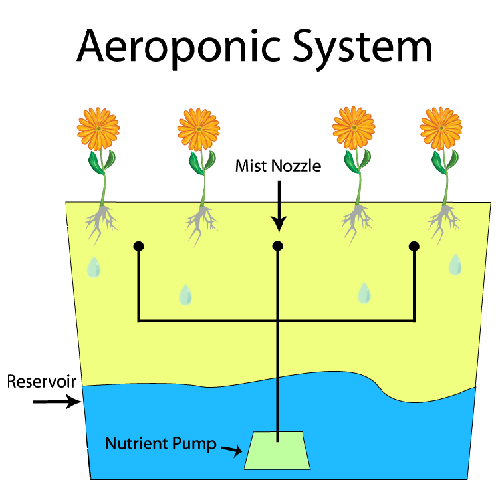
  • Container to hold the nutrient solution (a reservoir).
  • Submersible fountain/pond pump.
  • Tubing to distribute water from the reservoir pump to the mister heads in the growing chamber.
  • Enclosed growing chamber for the root zone.
  • Mister/sprinkler heads.
  • Water tight container for the growing chamber where the plants root systems will be.
  • Tubing to return the excess nutrient solution back to the reservoir. 
  • Timer (preferably a cycle timer) to turn on and off the pump.
How the aeroponic system operates is a fairly easy concept. First the purpose of the roots hang in mid air is so they can get the maximum amount of oxygen that they can get. The high volume of oxygen the roots get allows the plans to grow faster than they would otherwise, and the main benefit to this type of hydroponic system. 

Second, there is typically very little if any growing media is used, exposing all the plants roots. The plants are suspended either by small baskets, or closed cell foam plugs that compress around the plants stem. These baskets or foam plugs fit in small holes at the top of the growing chamber. The roots hang down inside the growing chamber where they get sprayed with nutrient solution from mister heads at regular short cycles. The regular watering cycles keep the roots moist and from drying out, as well as provides the nutrients the plants need to grow. 

The growing chamber the roots are in should be light proof, and almost air tight. It does need to allow fresh air in so the roots can get plenty of oxygen, but you don't want water to spill out, or pests to get in. Also you want the root chamber to hold in humidity. Ultimately what you want is the roots to get plenty of moisture, fresh oxygen, and nutrients. A a well designed aeroponics system provides a good balance of all three of those elements to the roots at the same time. 

Lastly, a major factor in aeroponic systems is the water droplet size. Roots sprayed with a fine mist will grow much faster, bushier, and with more surface area to absorb nutrients and oxygen with than roots sprayed with small streams of water like from small sprinkler heads. That translates into the plant canopy growing more rapidly as well. Aeroponic system types are categorized by the water droplet size.

You also can read : 3 Types Of Aeroponic System

Source : Homehydrosystems.com